


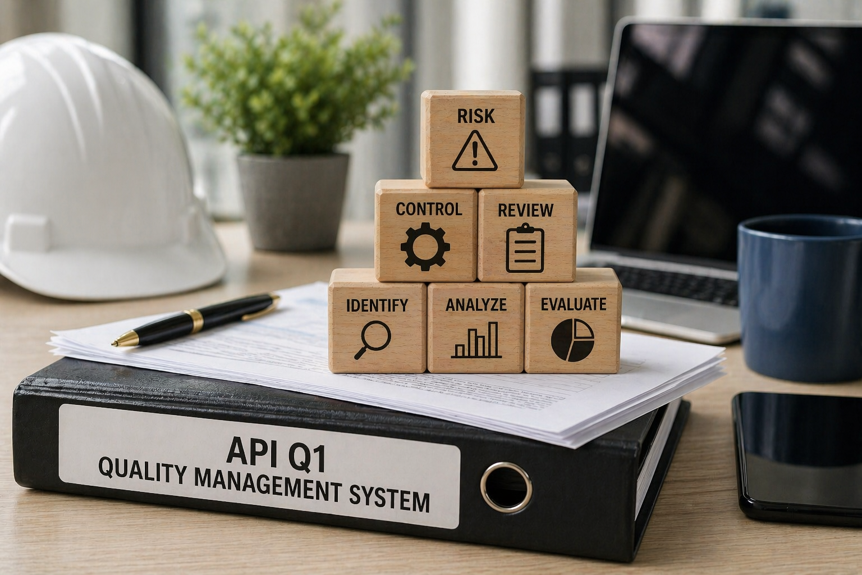
In today’s oil & gas industry, compliance with API Specification Q1 is no longer just about documentation—it’s about proactively managing risk across your operations.
Yet, in real-world audits, one issue keeps repeating:
Most companies believe they are implementing risk-based thinking—but they’re not doing it effectively.
This gap often leads to major nonconformities, audit failures, and operational risks.
Let’s break down where companies go wrong—and how to fix it.
Table of Contents
ToggleWhat Is Risk-Based Thinking in API Q1?
Risk-based thinking in API Q1 requires organizations to:
- Identify risks across processes
- Evaluate their impact on product quality and service delivery
- Implement controls to mitigate those risks
- Continuously monitor and improve
It’s not a one-time exercise—it’s a system-wide approach embedded in your QMS.
If your system only reacts to problems instead of preventing them, you’re not implementing risk-based thinking.
The Reality: What Audits Reveal
Based on industry audit experience, here’s what typically happens:
Risk Registers Exist—but Are Not Used
Companies create risk registers just to “tick the box.”
But:
- Risks are not linked to processes
- No ownership is assigned
- No updates are made
Result: Zero real impact
Risk Is Treated as a Separate Activity
Instead of integrating risk into operations, companies isolate it:
- No link to procurement
- No link to supplier evaluation
- No link to production or service delivery
Risk becomes a document—not a decision-making tool.
No Link Between Risk and Nonconformities
A major red flag in audits:
- Recurring failures occur
- But risk assessments are never updated
This shows a complete disconnect between real-world issues and the QMS.
Superficial Risk Scoring
Many organizations use:
- Generic scoring (High/Medium/Low)
- No clear criteria
- No consistency
This makes risk evaluation meaningless.
Why This Is a Serious Problem
Poor implementation of risk-based thinking can lead to:
- Audit nonconformities (major/minor)
- Supplier failures
- Product defects
- Delays in project delivery
- Increased operational costs
In high-risk environments like oil & gas, this isn’t just inefficiency—it’s exposure to critical failures.
What Effective Risk-Based Thinking Looks Like
To truly comply with API Q1, risk must be embedded across your organization:
1. Process-Level Risk Identification
Every critical process should have defined risks:
- Contract review
- Design & engineering
- Procurement
- Production
- Inspection & testing
2. Risk Linked to Decision-Making
Risk should directly influence:
- Supplier selection
- Inspection levels
- Resource allocation
- Project planning
But risk-based thinking doesn’t stop at selection. Continuous monitoring of supplier performance is critical to ensure risks remain under control.
Learn how to track and improve supplier outcomes in Supplier Performance Monitoring: Metrics and KPIs Post-Audit.
3. Dynamic Risk Register
Your risk register should:
- Be updated regularly
- Reflect real operational issues
- Include mitigation actions and owners
4. Integration with Nonconformity & CAPA
Every failure should trigger:
- Risk reassessment
- Preventive action updates
This is where most companies fail.
5. Data-Driven Risk Evaluation
Move beyond generic scoring:
- Use measurable criteria
- Define probability vs impact clearly
- Track trends over time
How to Fix Your Risk-Based Thinking (Action Plan)
Step 1: Map Risks to Processes
Identify risks at each stage of your operations.
Step 2: Define Clear Risk Criteria
Establish:
- Probability scales
- Impact definitions
Step 3: Integrate with Daily Operations
Ensure risk is part of:
- Meetings
- Planning
- Decision-making
Step 4: Link to CAPA System
Make risk updates mandatory after:
- Nonconformities
- Customer complaints
- Audit findings
Step 5: Train Your Team
Risk-based thinking should not be limited to quality teams—it must involve:
- Procurement
- Operations
- Engineering
- Management
Common Mistakes to Avoid
- Treating risk as documentation only
- Copy-paste risk registers
- No ownership or accountability
- Ignoring real operational data
- Not updating risks after failures
Final Thoughts
Risk-based thinking is not just a clause in API Q1—it’s the foundation of a resilient and effective quality management system.
If your organization is not actively using risk to drive decisions, you are not fully compliant.
And in today’s competitive oil & gas environment, that’s a risk you can’t afford.